Overview
Anubias barteri var. nana is a dwarf variety of Anubias barteri, a member of the arum family (Araceae) from the rivers and streams of West Africa — particularly Cameroon. In nature it grows on rocks and roots along the banks of shaded rivers, frequently partly emersed. It was described in 1979 and quickly became one of the best-selling aquarium plants in the world.
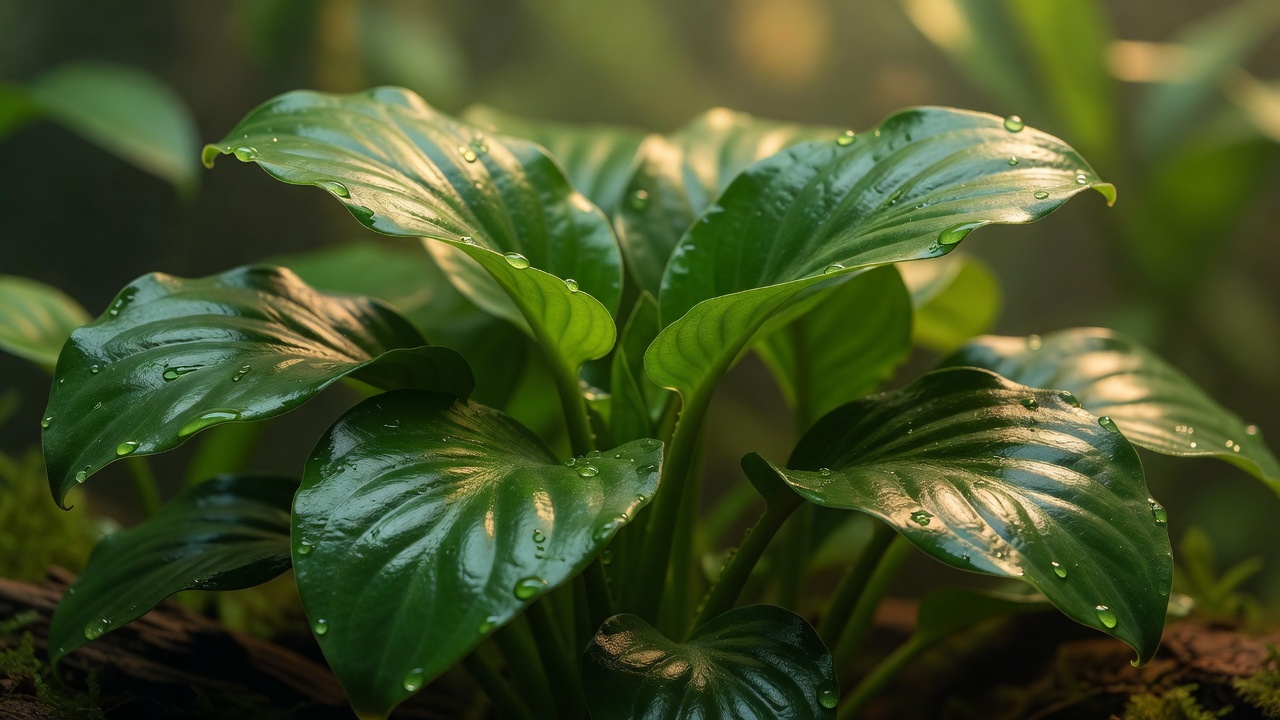
Like Java fern, it grows from a thick horizontal rhizome and absorbs nutrients mainly through its leaves. Its dark green, heart- to spear-shaped leaves are so thick and waxy that very few fish can eat them, and they last for years.
How to Plant Anubias Nana
Attach it to driftwood, rocks or ornaments — never bury the rhizome. Use cotton thread, fishing line or cyanoacrylate gel glue. If you want it to appear “planted” in the substrate, you can push only the roots into the gravel while the rhizome rests on the surface, or wedge it between pebbles.
Lighting, Nutrients & CO₂
Low light is not merely tolerated; it is preferred. Under strong lighting, the very slow-growing leaves become a surface for green spot algae and black beard algae. A weekly dose of complete liquid fertiliser supports healthy colour. CO₂ is not needed, and fertile soils provide little extra benefit because the plant is not a root feeder.
Growth, Maintenance & Propagation
Expect roughly one new leaf every two to three weeks. Maintenance is minimal: wipe algae off leaves with a soft brush and remove old yellowing leaves at the stem. To propagate, cut the rhizome into sections with at least three leaves each. Anubias also flowers underwater surprisingly often, producing a small white spathe typical of the arum family — a sign of a contented plant.
Common Problems
| Symptom | Likely cause | Solution |
|---|---|---|
| Hard green dots on leaves | Green spot algae, often from strong light or low phosphate | Lower light, move into shade, check phosphate levels, scrub gently. |
| Mushy, foul-smelling rhizome | Rhizome rot from burial or physical damage | Cut back to firm green tissue and reattach to decor. |
| Yellowing older leaves | Nitrogen or iron deficiency | Dose a complete liquid fertiliser weekly. |
| Melting leaves after purchase | Transition from emersed farm growth | Be patient; new submerged leaves will follow. |
Fish & Shrimp Compatibility
Anubias is one of the best choices for “difficult” tanks. It survives Malawi and Tanganyika cichlids, goldfish, silver dollars, plecos and even some puffers. In shrimp tanks, the broad leaves act as feeding platforms for cherry, crystal and Amano shrimp. Note that toxic sap is present in the plant tissue, as in many aroids, so avoid letting pets such as cats chew discarded leaves.
Popular Varieties
- Anubias nana ‘Petite’ — a miniature sport with leaves under 2 cm; perfect for nano tanks and moss-covered stones.
- Anubias barteri ‘Coffeefolia’ — textured, rippled leaves with bronze new growth.
- Anubias nana ‘Golden’ — bright lime-yellow leaves that add warmth to dark aquascapes.
- Anubias nana ‘Bonsai’ — compact, rounded leaves; an intermediate between Nana and Petite.
Pros & Cons
Pros
- Ideal for nano and low-light tanks
- Survives herbivorous and digging fish
- Leaves last for years
- Many decorative varieties
- No CO₂ or special substrate
Cons
- Very slow growth
- Prone to green spot algae in bright light
- Mature plants cost more than stem plants
- Rhizome must stay uncovered
Buying Tips & Typical Pricing
Choose plants with several firm leaves and a thick, green rhizome. Avoid specimens with algae-spotted leaves — algae on Anubias is hard to remove. Tissue-culture cups of ‘Petite’ are especially popular for nano tanks.
| Format | Typical retail price (approx.) | Best for |
|---|---|---|
| Potted Anubias nana | $7–14 / £6–10 | General use |
| Tissue-culture cup (Petite) | $9–13 / £7–10 | Nano & shrimp tanks |
| Pre-attached to wood or stone | $15–30 / £12–25 | Instant decoration |
Further Reading
Struggling with algae on slow plants? Our lighting, CO₂ and fertiliser guide explains how to balance light and nutrients.