Overview
The Amazon sword belongs to the genus Echinodorus in the water-plantain family (Alismataceae). Plants sold under this name are typically cultivated forms of Echinodorus grisebachii, a species complex native to tropical South and Central America, including the Amazon basin, where it grows in marshes and along river margins that flood seasonally.
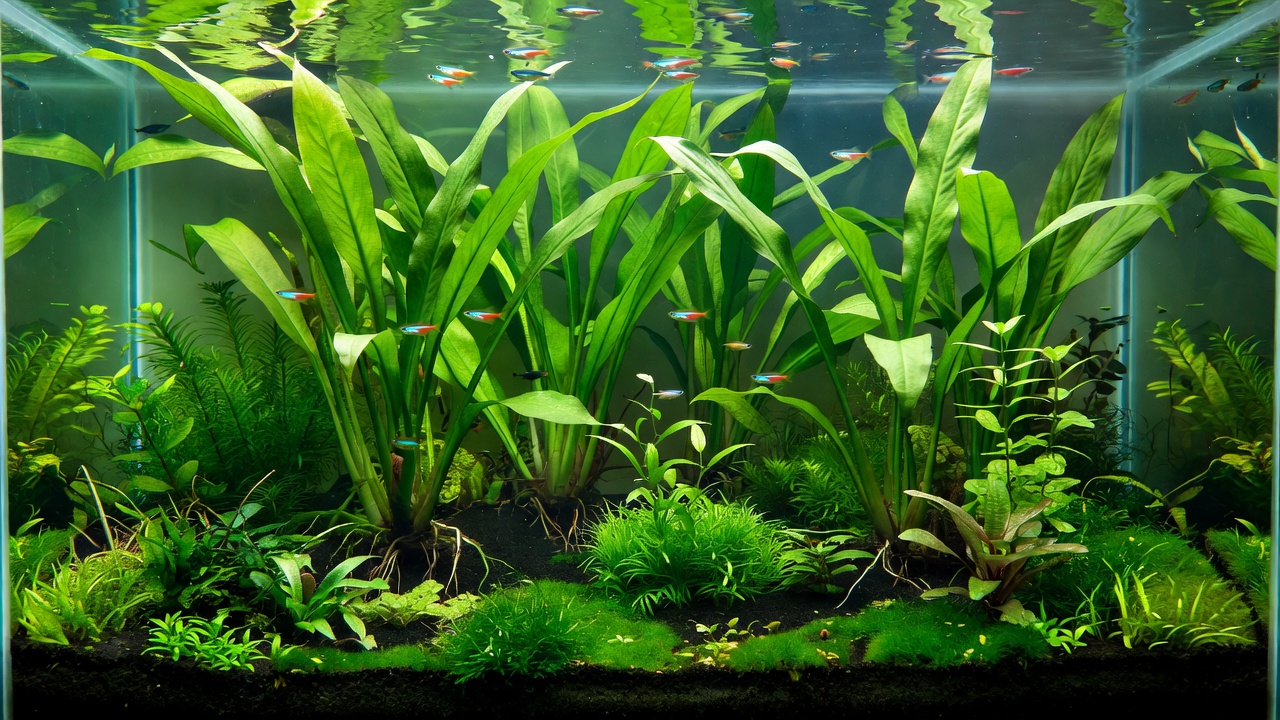
It forms a rosette: all leaves grow from a central crown just above the roots. Leaves are lanceolate, bright green and can reach 40–50 cm in tall tanks. Unlike Java fern and Anubias, the Amazon sword is a heavy root feeder, drawing most of its nutrition from the substrate.
How to Plant an Amazon Sword
- Remove the pot and rock wool, and trim roots to around 5 cm to encourage fresh root growth.
- Plant in at least 5–7 cm of substrate. Bury the roots only — keep the crown (where leaves emerge) just above the surface.
- In inert gravel or sand, push a root tab beneath the plant immediately and every 3–4 months after.
- Give it room: allow roughly 25–30 cm of horizontal space for a mature specimen.
Lighting, Nutrients & CO₂
Medium light is ideal. In very low light the plant stretches and slowly declines; in strong light without CO₂, nutrient deficiencies appear quickly. The single most important factor is nutrition: nutrient-rich aquasoil or regular root tabs containing iron, potassium and trace elements. A liquid fertiliser helps too. CO₂ is optional but accelerates growth and produces larger, healthier leaves.
Growth, Maintenance & Propagation
Once settled, expect one to two new leaves per week. Remove old outer leaves when they yellow or collect algae, cutting close to the crown. Mature plants send out long flower stalks (runners) that produce daughter plants along their length. Let the daughters develop several leaves and roots, then cut them free and plant them, or simply weigh the runner down so the plantlets root next to the mother.
Common Problems
| Symptom | Likely cause | Solution |
|---|---|---|
| Leaves melt in the first weeks | Transition from emersed (farm) to submersed growth | Remove dying leaves; new narrower underwater leaves will appear. |
| Pale or yellow new leaves | Iron deficiency | Add iron-rich root tabs; consider a liquid iron supplement. |
| Pinholes in older leaves | Potassium deficiency | Dose potassium or a complete fertiliser. |
| Plant floats up | Fish digging or shallow planting | Replant deeper and surround with stones until roots establish. |
Fish & Shrimp Compatibility
The broad leaves are favourites for angelfish and discus, which may lay eggs on them. Tetras, rasboras, gouramis, corydoras and shrimp are all excellent companions. Avoid goldfish, large plecos, silver dollars and digging cichlids such as oscars, which uproot or shred the plant. Some snail species may graze on soft, dying leaves but rarely harm healthy ones.
Related Varieties
- Echinodorus ‘Ozelot’ — a hybrid with red-brown spotted leaves; tough and attractive.
- Echinodorus ‘Red Flame’ — vivid red-speckled foliage, best with stronger light.
- Echinodorus ‘Rubin’ — deep red-brown leaves, large and robust.
- Pygmy chain sword (Helanthium tenellum) — a small grassy relative used for carpets.
Pros & Cons
Pros
- Dramatic centrepiece plant
- Absorbs nutrients quickly, competes with algae
- Propagates freely via runners
- Spawning site for angelfish and discus
- Inexpensive for its size
Cons
- Too large for small tanks
- Needs root tabs or rich soil
- Initial leaf melt alarms beginners
- Can shade out smaller plants
Buying Tips & Typical Pricing
Choose plants with a firm crown and white or light-coloured roots. Expect large, broad emersed leaves at purchase; they will be replaced underwater. Tissue-culture versions start small but adapt quickly without melting as much.
| Format | Typical retail price (approx.) | Best for |
|---|---|---|
| Potted plant | $6–15 / £5–11 | Most tanks |
| Tissue-culture cup | $8–12 / £6–10 | Clean start, no pests |
| Large mother plant | $20–35 / £15–28 | Instant focal point |
Further Reading
Understand root tabs, aquasoil and nutrient dosing in our lighting, CO₂ and fertiliser guide, and see how swords dominate classic Dutch and jungle layouts.